

Document format
T602
T602 refers here to DOS Text602 documents, part of the Czech and Slovak personal-computing heritage. Text602 combined editable prose with compact commands for formatting and printing on contemporary PC hardware.
Learn more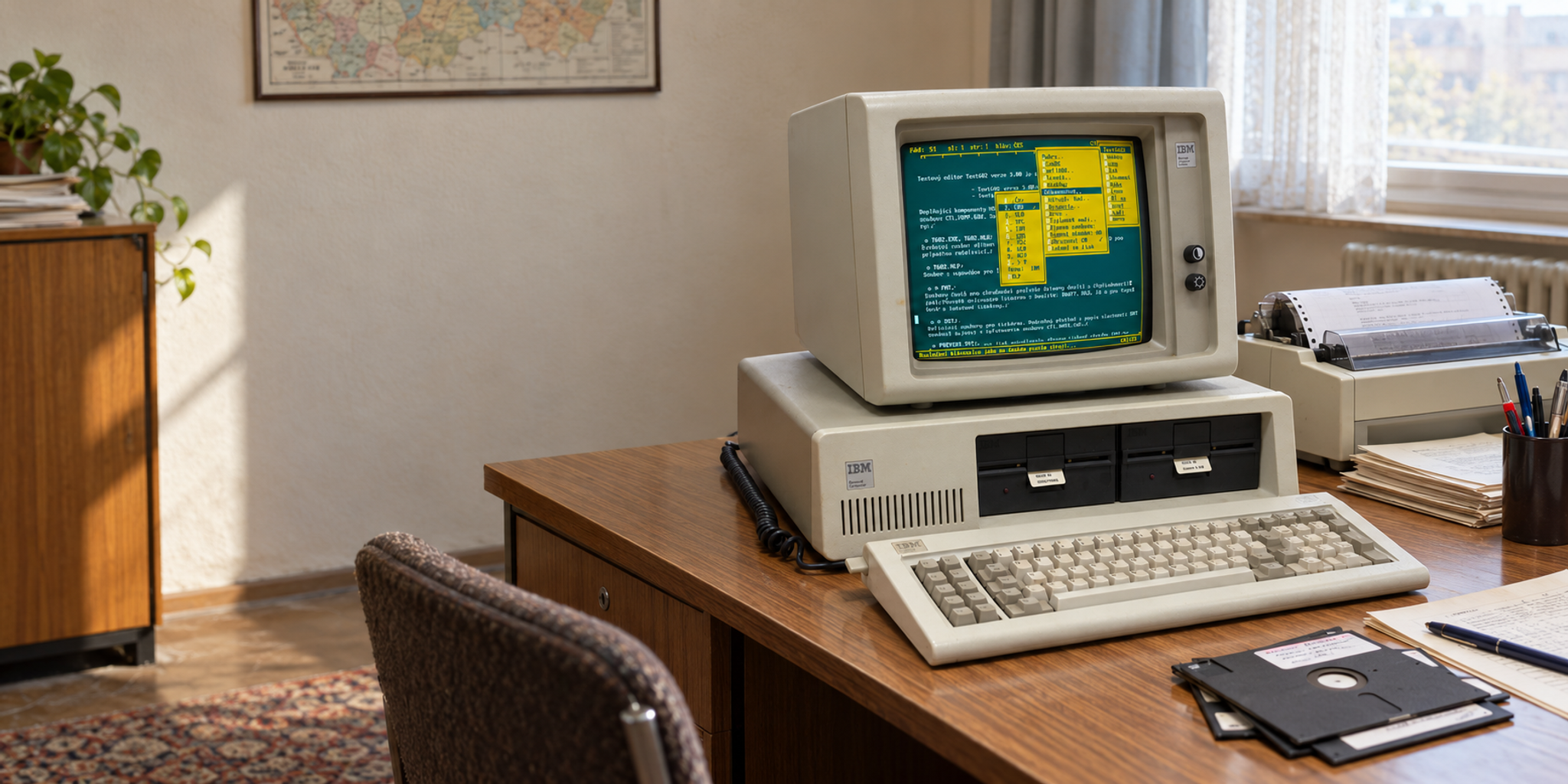
Convert from T602
Available conversions · 14
Conversion is available locally in your browser. VALIDATED records tested, bounded profiles; EXPERIMENTAL records provisional acceptance. Neither status promises complete preservation or support for every file.
What is the format?
T602 refers here to DOS Text602 documents, part of the Czech and Slovak personal-computing heritage. Text602 combined editable prose with compact commands for formatting and printing on contemporary PC hardware. Such a file is not simply a modern UTF-8 text document, and it is not the later Windows 602Text binary format. Reading it correctly requires knowledge of its control syntax and character repertoire.
Technical profile
The cards describe the file format. Conversion boundaries are explained below.
History and evolution
Software602’s historical materials place Text602 in 1989, in the Czechoslovak PC and DOS environment. Local-language writing required solutions for Czech and Slovak diacritics before Unicode became normal. Documents and print commands reflected dot-matrix printers and limited display modes. Surviving Text602 3.00 manuals provide stronger evidence for that version than an assumed universal specification of every earlier variant. Later 602Text products used different storage and should not be conflated with DOS files.
Related formats
Compare document models and their uses.
Technical architecture
A DOS Text602 file mixes byte-oriented text with control bytes and command lines, including charset declarations and printer settings. Some commands affect display marks; others describe physical printing. High-byte characters depend on the selected repertoire. Kamenický/KEYBCS2, Text602 Latin2 and standard DOS CP852 are not interchangeable labels. A .602 or historical .TXT name does not prove either syntax or encoding.
Control syntax before character decoding
A historical text file can contain meaningful byte controls alongside letters. Decoding the entire stream as ordinary text first can lose the distinction between a print command and a character. UTCE therefore parses Text602 byte syntax before mapping text to Unicode. This preserves a record of unsupported commands and explicit encoding decisions. It also prevents a convenient modern decoder from silently substituting replacement characters and making a damaged interpretation look complete.
Recovering prose without inventing structure
Old authors often used spaces, tabs and printer modes to make headings or columns look aligned. That appearance is not sufficient evidence of semantic headings, lists or tables. UTCE’s Text602 profile avoids heuristic reconstruction of those structures. It preserves supported paragraphs and text marks, while describing print geometry and unsupported modes as limitations. For archival work, a faithful readable transcription with disclosed limits can be more useful than an apparently rich document containing invented relationships.
Real-world applications
Municipal archives, old correspondence, legislation and personal collections can contain Text602 documents. Migration is often about recovering readable Central European prose rather than recreating a printer-specific page. Preserve the original bytes, note the selected encoding and compare the recovered text against a period printout when available. Names, dates and diacritics deserve particular attention.
Advantages and limitations
Compact storage and local-language editing made the format useful in its era. Today the difficulty is interpretation: a wrong code page can produce plausible but incorrect letters. Alignment made with spaces is not evidence of a table. Printer fonts, wide or tall modes and page geometry need an explicit migration decision. Replacing unreadable characters silently can destroy evidence that would permit a better later recovery.
Compatibility and software
LibreOffice maintains a Text602 import filter, and historical specialist converters document DOS commands. Neither that filter nor UTCE makes all generations of 602 software identical. An archive should keep a migration record linking source bytes, application/profile, encoding choice and resulting Unicode text. A newer 602Text OLE file needs a different reader.
Conversion considerations
UTCE’s source-only profile accepts bounded DOS Text602 3.00 prose. It parses byte syntax before decoding characters and can preserve paragraphs, soft breaks, bold, italic, underline and explicit page breaks. Undeclared high-byte text requires encoding selection. CT1 byte 0x92 is ambiguous and automatic interpretation rejects; CP852 is an explicit override, not an alias for Text602 Latin2. KOI8-CS and Windows OLE reject. Headers become labelled prose; print layout and pictures have explicit losses.
Frequently asked questions
Why does an old document show the wrong Slovak letters?
The same byte can represent different letters in different repertoires. Select the actual encoding and compare known words. Text602 Latin2 must not automatically be treated as standard CP852.
Can UTCE create a new T602 file?
No. The current profile is source-only; target directions are absent from the evidence ledger.
Is every file called .602 a DOS Text602 document?
No. Content and generation matter. Later Windows formats and damaged files cannot be identified safely from the extension alone.